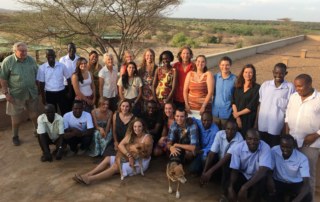
Fall 2016 Field School ends :(

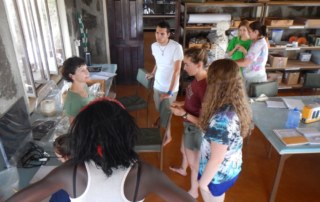
This past semester has been one to remember. The students learned about the Ecology of the Turkana Basin, being able to identify all the common plant species in the region and understanding how animals foraging on these plants have affected the environment. They learned about the Geology of the Turkana Basin, where each and every [...]

2017-01-04T18:04:29+03:00November 30th, 2016|Fall 2016, Field Schools|Comments Off on Fall 2016 Field School ends :(

Becoming a master knapper

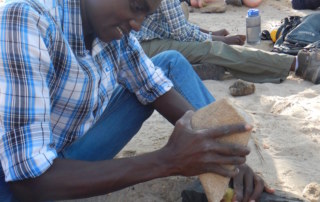
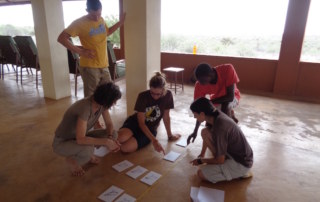
After returning to TBI from an exciting camping trip, we spent the afternoon relaxing and knapping! We used the raw material we had collected in the field: though everyone put their initials on the material collected, some students decided to share what they had collected (our students were so thoughtful, but whatever happened to survival [...]

2017-01-04T18:04:29+03:00November 21st, 2016|Fall 2016, Field Schools|Comments Off on Becoming a master knapper

Trip to Nariokotome

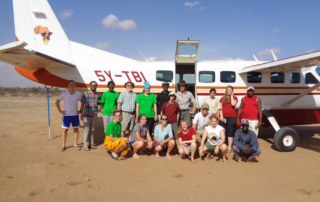
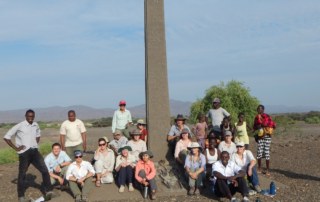
We left TBI Turkwel Monday morning for our camping trip, from which we would be returning on Wednesday afternoon. We would be camping for two nights near the village of Nariokotome; the famous hominin site of Nariokotome boy, KNM-WT 15000, is only a few minutes away! On our drive to Nariokotome, we would be making [...]

2017-01-04T18:04:29+03:00November 19th, 2016|Fall 2016, Field Schools|Comments Off on Trip to Nariokotome

Rolling back to the Holocene

On Friday, we traveled to the Holocene site of Napaget, a massive and artefact-rich sand dune that overlooks the beautiful Lake Turkana. The site is about an hour away (as the lorry drives), and on the way we passed some truly impressive termite mounds, almost big enough for a person to live in (I wonder [...]

2017-01-04T18:04:30+03:00November 14th, 2016|Fall 2016, Field Schools|Comments Off on Rolling back to the Holocene

Afternoon Knaps

The next morning in class, we were introduced to archaeological vocabulary, necessary to accurately understand and describe stone artefacts. We learned how to describe the physical characteristics, such as: ventral (internal) and dorsal (external) sides of a flake; cortex, or the external skin of the original rock; and negatives (signs of a flake removal) and positives [...]

2017-01-04T18:04:30+03:00November 13th, 2016|Fall 2016, Field Schools, General|Comments Off on Afternoon Knaps

Using tools and monkeying around

For the last module of the TBI Origins Field School, Archaeology of the Turkana Basin, we headed to the west side of the lake. On this side, the students will be living at the TBI Turkwel Research Facility which is set up very similar to Ileret. However, we are now not too far from world [...]

2017-01-04T18:04:30+03:00November 8th, 2016|Fall 2016, Field Schools|Comments Off on Using tools and monkeying around

Crawling for Monkeys and a Friendly Farewell

Because of the successful end of our last excursion in the field, we returned to the same site to try to find other remnants of this ancient primate. When we got back, we did a hill crawl to cover the area below the find, with the thought that over time the fossil skeleton may have [...]

2017-01-04T18:04:30+03:00November 6th, 2016|Fall 2016, Field Schools|Comments Off on Crawling for Monkeys and a Friendly Farewell

What do our teeth tell us?

In Human Evolution this week, we discussed how animals with different diets will have coinciding differences in their teeth morphology as well as in other cranial areas, such as the zygomatic and mandible. Similar dietary morphology patterns are observed in hominins as well, which can tell us a lot about both the environment they were living in [...]

2017-01-04T18:04:31+03:00November 3rd, 2016|Fall 2016, Field Schools|Comments Off on What do our teeth tell us?

What do the TBI field school students do during their free-time?

During the TBI field school, it is important to take time off from studying and have a bit of leisure time. When the students are constantly working, may it be preparing for an exam or putting together a presentation, it is sometimes hard to stop and take a break. However, we always make sure the students [...]

2017-01-04T18:04:31+03:00November 1st, 2016|Fall 2016, Field Schools|Comments Off on What do the TBI field school students do during their free-time?

Discovering Hominins

Following our first two days of class in the lab, we spent the day in the field Wednesday visiting the site of an important hominin discovery. In an attempt to beat the heat, we boarded the lorry at 7 a.m. to get an early start, arriving in Area 10 by 7:45. Sale and Apolo lead [...]

2017-01-04T18:04:31+03:00October 29th, 2016|Fall 2016, Field Schools|Comments Off on Discovering Hominins

Walking into our past

The students have completed three modules thus far and are now at the beginnings of what many students came to TBI for: Human Evolution. Being home to one of the most extensive collection of fossil hominins, Turkana Basin is the ideal place to learn about human prehistory. Specimens like Paranthropus boisei, Homo rudolfensis, Homo habilis, [...]

2017-01-04T18:04:31+03:00October 26th, 2016|Fall 2016, Field Schools|Comments Off on Walking into our past

Prospecting and Excavating in the Field

The second week of Paleontology was primarily spent in the field: for four of the six class days this week, we spent the entire day in the field, using what we learned in the previous week to find and identify fossils. Though a majority of the time was spent prospecting, we also learned the methods [...]

2017-01-04T18:04:31+03:00October 19th, 2016|Fall 2016, Field Schools|Comments Off on Prospecting and Excavating in the Field

Sculpting a fossil hunter

This past week in paleontology, the students spent time in lab learning how to identify bones of mammalian species found in the Turkana Basin and understanding differences in functional morphology. This is an important skill set because when we go into the field next week, the students will be able to identify any fossils they find. On Saturday, [...]

2017-01-04T18:04:32+03:00October 17th, 2016|Fall 2016, Field Schools|Comments Off on Sculpting a fossil hunter

Osteology and FUNctional Morphology

We started the Paleontology module from a broad perspective, making sure to cover a brief history of life on earth as well as the history of evolutionary theory, including the work of such academic greats as Mayr, Simpson, and Dobzhansky. With such a solid base under our belts, we can now start learning mammalian anatomy! To [...]

2017-01-04T18:04:32+03:00October 15th, 2016|Fall 2016, Field Schools|Comments Off on Osteology and FUNctional Morphology

Timelines and Phylogenetic Fun!!

So far in the TBI field school, the students learned about the Ecology of the Turkana Basin, understanding how wildlife has greatly impacted the landscape, how vectors can spread disease, and how different animals interact. They saw zebra, giraffe, gazelle, elephants, baboons, cheetahs and they even got to pet a rhino! They then transitioned to [...]

2017-01-04T18:04:32+03:00October 13th, 2016|Fall 2016, Field Schools|Comments Off on Timelines and Phylogenetic Fun!!

Traces of Contention

In just two short weeks, the students have learned more about the geology of the Turkana Basin than any of them may have expected. Little did they know that it would prepare them for their future modules, teaching them to be more aware of their surroundings and exactly what type of environment to look for [...]

2017-01-04T18:04:32+03:00October 9th, 2016|Fall 2016, Field Schools|Comments Off on Traces of Contention

Going back to where it all began… Koobi Fora

Map of the Koobi Fora Region As an educational and celebratory culmination to the geology module, we went on a geology-based camping trip to the Koobi Fora region, particularly close to where Richard Leakey established the Koobi Fora Base Camp in 1968. In the early 1970s Richard and Meave Leakey led a crew [...]

2017-01-04T18:04:32+03:00October 7th, 2016|Fall 2016, Field Schools|Comments Off on Going back to where it all began… Koobi Fora

Coring in the Ileret Delta

Throughout the history of the Turkana Basin, the dominant hydrographic systems that have fluctuated throughout the basin have been fluvial and lacustrine systems. While this fluctuating environment has been a main theme throughout most of the Geology module, students are now turning to studying current day environments to better understand sediment accumulation in past environments. While [...]

2017-01-04T18:04:32+03:00October 3rd, 2016|Fall 2016, Field Schools|Comments Off on Coring in the Ileret Delta

The present is the key to the past…

Lake Turkana (Present); Lokochot Lake (3.5 Ma); Lonyumun Lake (4.1-3.95 Ma) The idea that the same natural laws and processes that operate on Earth today have operated in the past is an assumption many geologists use in order to better understand the geologic past. This idea is known as uniformitarianism, also defined as “the [...]

2017-01-04T18:04:32+03:00October 2nd, 2016|Fall 2016, Field Schools|Comments Off on The present is the key to the past…
Go to Top