Origins Field School

Sculpting a fossil hunter

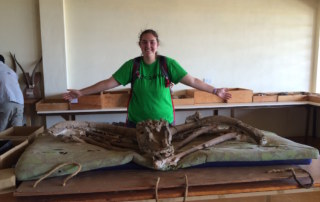
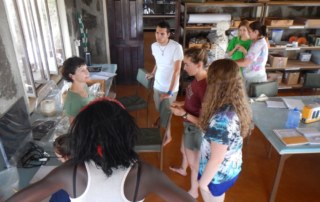
This past week in paleontology, the students spent time in lab learning how to identify bones of mammalian species found in the Turkana Basin and understanding differences in functional morphology. This is an important skill set because when we go into the field next week, the students will be able to identify any fossils they find. On Saturday, [...]
2017-01-04T18:04:32+03:00October 17th, 2016|Fall 2016, Field Schools|Comments Off on Sculpting a fossil hunter

Osteology and FUNctional Morphology

We started the Paleontology module from a broad perspective, making sure to cover a brief history of life on earth as well as the history of evolutionary theory, including the work of such academic greats as Mayr, Simpson, and Dobzhansky. With such a solid base under our belts, we can now start learning mammalian anatomy! To [...]

2017-01-04T18:04:32+03:00October 15th, 2016|Fall 2016, Field Schools|Comments Off on Osteology and FUNctional Morphology

Timelines and Phylogenetic Fun!!

So far in the TBI field school, the students learned about the Ecology of the Turkana Basin, understanding how wildlife has greatly impacted the landscape, how vectors can spread disease, and how different animals interact. They saw zebra, giraffe, gazelle, elephants, baboons, cheetahs and they even got to pet a rhino! They then transitioned to [...]

2017-01-04T18:04:32+03:00October 13th, 2016|Fall 2016, Field Schools|Comments Off on Timelines and Phylogenetic Fun!!

Traces of Contention

In just two short weeks, the students have learned more about the geology of the Turkana Basin than any of them may have expected. Little did they know that it would prepare them for their future modules, teaching them to be more aware of their surroundings and exactly what type of environment to look for [...]

2017-01-04T18:04:32+03:00October 9th, 2016|Fall 2016, Field Schools|Comments Off on Traces of Contention

Going back to where it all began… Koobi Fora

Map of the Koobi Fora Region As an educational and celebratory culmination to the geology module, we went on a geology-based camping trip to the Koobi Fora region, particularly close to where Richard Leakey established the Koobi Fora Base Camp in 1968. In the early 1970s Richard and Meave Leakey led a crew [...]

2017-01-04T18:04:32+03:00October 7th, 2016|Fall 2016, Field Schools|Comments Off on Going back to where it all began… Koobi Fora

Coring in the Ileret Delta

Throughout the history of the Turkana Basin, the dominant hydrographic systems that have fluctuated throughout the basin have been fluvial and lacustrine systems. While this fluctuating environment has been a main theme throughout most of the Geology module, students are now turning to studying current day environments to better understand sediment accumulation in past environments. While [...]

2017-01-04T18:04:32+03:00October 3rd, 2016|Fall 2016, Field Schools|Comments Off on Coring in the Ileret Delta

The present is the key to the past…

Lake Turkana (Present); Lokochot Lake (3.5 Ma); Lonyumun Lake (4.1-3.95 Ma) The idea that the same natural laws and processes that operate on Earth today have operated in the past is an assumption many geologists use in order to better understand the geologic past. This idea is known as uniformitarianism, also defined as “the [...]

2017-01-04T18:04:32+03:00October 2nd, 2016|Fall 2016, Field Schools|Comments Off on The present is the key to the past…

Navigating Through the Turkana Basin!

Understanding the basin's fluctuating history provides a more complete picture of what factors may have affected early life in this region. Vital to this research is mapping, the ability to show features on the landscape and to mark areas of interest that can be relocated. Back in the 1970s when some of the first paleoanthropological expeditions began, navigating in the field [...]

2017-01-04T18:04:33+03:00October 1st, 2016|Fall 2016, Field Schools|Comments Off on Navigating Through the Turkana Basin!

Geology week 1: Introduction to Sedimentology and Stratigraphy of the Turkana Basin

For this module, titled Sedimentary Geology and Geochronology of the Turkana Basin, Professor R. Linda Martin will be leading the students back in time as we reconstruct the past landscapes of the Turkana Basin. Professor Martin is currently the Academic Director for the Origins Field School and has been conducting research in the Turkana Basin since 2011. [...]

2017-01-04T18:04:33+03:00September 28th, 2016|Fall 2016|Comments Off on Geology week 1: Introduction to Sedimentology and Stratigraphy of the Turkana Basin

Safari Salama Dr. Martins!

One of the final concepts we learned about in ecology was the relationships between organisms.  Specifically, the relationship between intimacy (a measurement of the proximity in which these animals interact) and lethality (how harmful the relationship is). For example, a lion and a zebra would have low intimacy and high lethality, because they spend very [...]

2017-01-04T18:04:33+03:00September 27th, 2016|Fall 2016, Field Schools|Comments Off on Safari Salama Dr. Martins!

A rose in a desert

On Tuesday, the field school explored near the edge of Sibiloi National Park to learn more about adaptive strategies of vegetation in such an arid environment. In particular, we focused on the desert rose, Adenium obesum, a rather amazing tree. The desert rose is an incredibly slow growing tree, growing an average of 1 millimeter [...]

2017-01-04T18:04:33+03:00September 26th, 2016|Fall 2016, Field Schools|Comments Off on A rose in a desert

Impact of grazers at Mpala and Ileret

While at Mpala, Dr. Martins took the students out into the field to learn about the different species of plants surrounding the area. Similar to the overall theme that Kimani introduced, Dr. Martins had the students work on a project that stressed the differences of vegetation inside and outside of the compound. The students conducted [...]

2017-01-04T18:04:33+03:00September 25th, 2016|Fall 2016, Field Schools|Comments Off on Impact of grazers at Mpala and Ileret

Ecology Week 2: Vectors

The field school spent a few days learning about vectors, parasites, and the effect they have on people and the communities in the Turkana Basin. A vector is an animal that actively or passively transmits a pathogen from one organism to another; the most obvious example would be the mosquito, whose diverse family is known [...]

2017-01-04T18:04:33+03:00September 25th, 2016|Fall 2016, Field Schools|Comments Off on Ecology Week 2: Vectors

Trip to Ol Pejeta Conservancy!

On Thursday, the students traveled to Ol Pejeta Conservancy, the world's largest black rhino sanctuary and home to three of the worlds last remaining northern white rhinos. Ol Pejeta is not only home to these extremely rare rhinos but hundreds of zebra, gazelle, impala, elephants, baboons and even lions! Although not native to Kenya, the students even had the [...]

2017-01-04T18:04:34+03:00September 19th, 2016|Fall 2016, Field Schools|Comments Off on Trip to Ol Pejeta Conservancy!

Ecology Week 1: Vegetation and Herbivory at Mpala

On Monday and Tuesday, we had the opportunity to learn from Mpala researcher Kimani Ndung'u who specializes in vegetation studies and is currently investigating the effects of termite mounds on the locale-specific environment. He is also a part of a project (www.forestgeo.si.edu/site/mpala) run by the Smithsonian Tropical Research Institute where they are collecting data for the only savannah plot in their global network. [...]

2017-01-04T18:04:34+03:00September 17th, 2016|Discovery, Fall 2016, Field Schools|Comments Off on Ecology Week 1: Vegetation and Herbivory at Mpala

Fall 2016 Origins Field School Begins!

Welcome to the Turkana Basin Institute Field School blog. We will post weekly updates of students’ adventures and will also discuss what we are all learning along the way. There are 5 modules over the next 10 weeks- Ecology, Geology, Paleontology, Human Evolution, and Archaeology. Please share with others that might be interested in what the [...]

2017-01-23T09:50:18+03:00September 12th, 2016|Fall 2016, Field Schools|Comments Off on Fall 2016 Origins Field School Begins!

Congratulations to the Spring 2016 TBI Field School Graduates

Finally we bring the Spring 2016 TBI Field School to a close. The students have learned and accomplished so much during these 10 weeks. More importantly, they've made friends and memories that will surely last a lifetime. The students have gained a huge breadth of knowledge through many hours of studying, researching, hiking and exploring. [...]

2017-01-04T18:04:34+03:00April 3rd, 2016|Field Schools, Spring 2016|Comments Off on Congratulations to the Spring 2016 TBI Field School Graduates

A site tour around Nariokotome, the archaeology of the Holocene, and a bit of digging in the dirt

The Early Pleistocene archaeological sites on the west side of Late Turkana are some of the richest areas for early hominin behavioral research in the world. Dozens of sites provide large quantities of stone tools made on a range of different raw materials. Intensive archaeologists studies in this area attempt to reconstruct hominin movements and [...]

2017-01-04T18:04:35+03:00April 1st, 2016|Field Schools, Spring 2016|Comments Off on A site tour around Nariokotome, the archaeology of the Holocene, and a bit of digging in the dirt

Making, using, and understanding stone tools

We switched our focus in the Archaeology module back to the Stone Age, starting with some hands-on learning about ancient stone tool technology. Understanding stone tools by simply observing archaeological artifacts is a tricky thing - even seeing that these objects are artifacts can be challenging if you don't have years of experience. Many archaeologists have [...]

2017-01-04T18:04:35+03:00March 27th, 2016|Field Schools, Spring 2016|Comments Off on Making, using, and understanding stone tools

A visit from Richard and Meave Leakey and Kenyan cultural heritage

Profs. Richard and Meave Leakey stopped by TBI Turkwel for a visit with the field school students in between the end of the Paleoanthropology module and the start of Archaeology. The students have come a long way in this field school and were excited to hear from Prof. Leakey about his work and life in [...]

2017-01-04T18:04:35+03:00March 18th, 2016|Field Schools, Spring 2016|Comments Off on A visit from Richard and Meave Leakey and Kenyan cultural heritage
Go to Top