Giving to TBI

Background

During the early planning stages of TBI, a decision was made by the Leakeys and their partners at Stony Brook to develop TBI by raising private gifts to support the project. The Kenyan Government is not in a position to guarantee long-term funding to support scientific projects, and it is our goal to ensure that the infrastructure to enable scientific work in the Turkana Basin will always be available. Efforts to raise the financial support to build and equip the two field stations have been quite successful, although there remains much to be done. Notable donors are identified with the mission objectives and more are expected to come on board.

TBI is already playing a valuable role and its potential for scientific studies and community development is obvious. The scope for academic excellence on a truly multi-national and interdisciplinary scale is exciting. The challenge now is to complete our work. I really need your help to achieve this.

- Richard Leakey

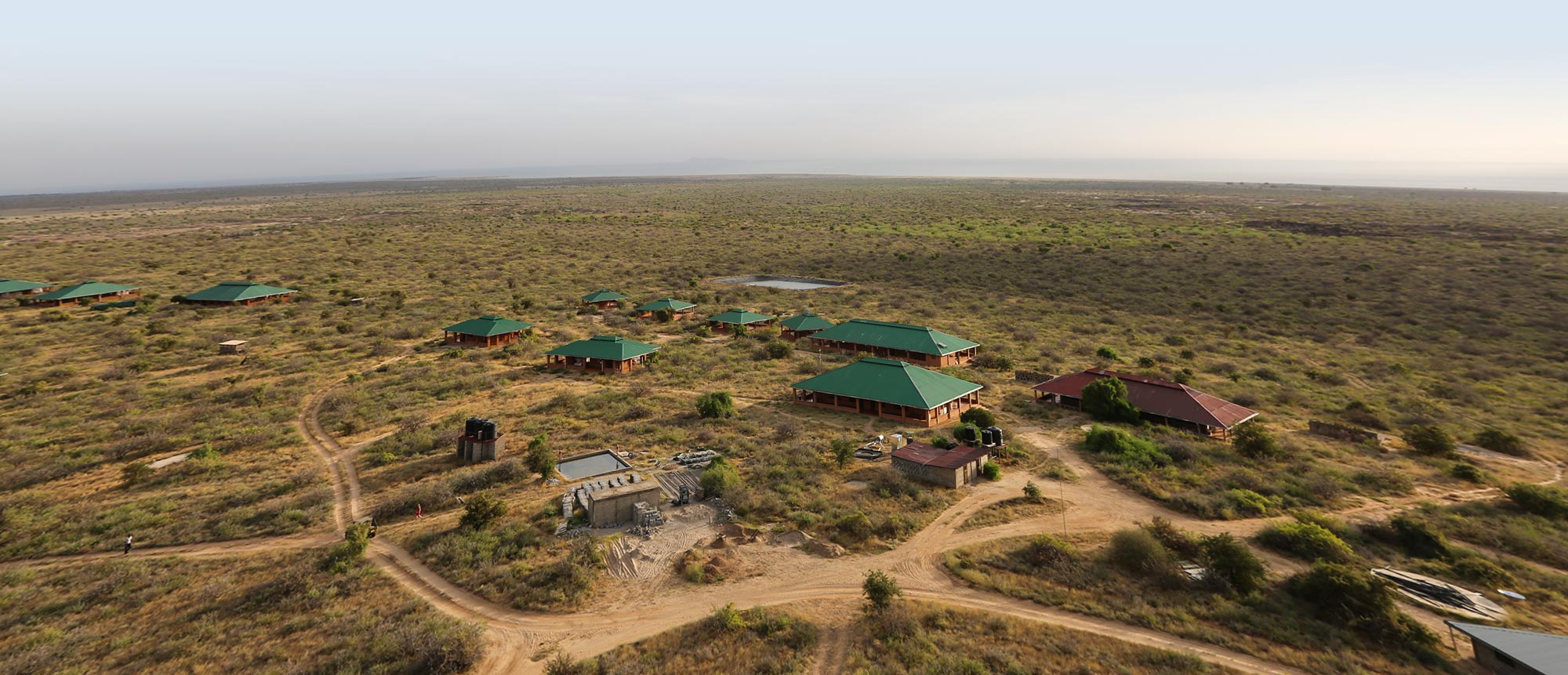
Phase 1 of the TBI project required raising funds to build and equip a facility at Ileret that would support year-round field research and community projects, to locate a suitable site for a facility on the west side of the lake and to begin to support Kenyan postdoctoral scientists and graduate fellows. Our initial estimate was that these goals would require $2.4M but Phase 1 was completed by the end of 2007 for about $1.8M. Part of the reason that the costs were reduced was that Stony Brook University funded TBI-Stony Brook fully on an ongoing basis so that administrative costs to the funds raised were minimized and almost all of the monies were used for construction, to equip the facility and to support young scientists.

Phase 2 of TBI began in 2008 with a plan to raise $10M over the next three to five years to enable construction of a permanent facility at Turkwel, the replacement of the long-term camp at Ileret with a permanent facility, equipping both the supply chain for the facilities and the infrastructure to support research. Jim and Marilyn Simons had supported Phase 1 of TBI and generously committed a $5M challenge grant from the Simons Foundation to help to raise the additional $5M required by offering a dollar for dollar match for all other funds contributed to support Phase 2 of TBI. The effectiveness of their challenge grant is clearly evident as the pace of fund-raising increased dramatically when the challenge grant was announced early in 2008 (see Figure 1 below). One of the main fund-raising efforts was led by Ian Telfer and Jussi Westergren in Vancouver. Paul Simon visited TBI with his wife and children in August 2008 and offered to help with TBI fund-raising by performing at an event that would contribute at least $1M to TBI. Ian and Jussi organized a wonderful dinner in Vancouver in September 2009, which raised $1M and drew down a $1M match from the Simons’ Challenge grant, thus contributing $2M towards Phase 2 of TBI. A similar event is currently being planned to take place in New York City.

Long term financing for TBI will derive from three main sources:

  1. The field school will provide a revenue stream that will cover many of the operating costs of the facility at Turkwel (and later at Ileret) through reasonable charges for facilities use, vehicle use etc. Running a facility year round requires year round staff and operating costs so it is our intent to offset these annual costs to the maximum extent possible by maximizing facility use during the academic year. Running costs and vehicle costs will be amortized on a 50% use basis so that the field schools’ use of the facility for 20 weeks per year will provide almost 80% of the operational and renewal costs for the Turkwel facility.
  2. A second revenue stream will be generated by the use of the field facilities by scientific researchers. Reasonable facility use charges (much lower than those for free standing projects equipping themselves) are expected to generate sufficient resources to meet a major part of the ongoing operational recurrent costs. Facilities use by scientific projects will be concentrated in the summer months when faculty from European and US universities are not teaching.
  3. Phase 3 of TBI fund-raising will seek to raise funds to endow the scientific research program. The support of research year round is essential if we are to ensure that this research infrastructure (both physical and human) remains available regardless of external factors such as the possibility of reduced facilities use due to travel restrictions resulting from a global pandemic , such as Avian flu. It is conceivable that an entirely revenue based plan to sustain TBI would be vulnerable to such challenges and it would be irresponsible for TBI to depend entirely on user fees to ensure the sustainability of the research infrastructure that TBI provides.
Figure 1: TBI Fundraising & Funding, 6/2005 to 6/2010.

Figure 1: TBI Fundraising & Funding, 6/2005 to 6/2010.

The plans for the next two to three years involve completion of construction of the full campuses at Ileret and at Turkwel, the construction of a GIS base station to serve numerous research project on the Lake and in the Basin, athe construction of a small hospital on the east side of the lake at Ileret. The most important project is to complete fundraising for Phase 2 to complete construction of the infrastructure and then to raise an endowment to ensure the infrastructure provided by TBI to persist in perpetuity.

Contributing to the endowment will secure the future of the research. All contributions to the Stony Brook University Foundation/TBI, a 501(c)(3) not-for-profit corporation are tax deductible, as allowed by law.
For more information on giving to TBI, please contact:

Sarah K. Abruzzi
Turkana Basin Institute
Stony Brook University
488 Administration Building
Stony Brook, NY 11794-1601
(631) 632-4608 phone
(631) 632-4486 fax
sarah.abruzzi@stonybrook.edu