demingyang

About Deming Yang

Hello! My name is Deming Yang. I am the Resident Academic Director for the Origins Field School, Spring 2018. I am a PhD candidate in the IDPAS program at Stony Brook University and a TBI graduate fellow. Before joining Stony Brook for graduate school, I worked in Kenya for three years and gained amazing field experience. I have broad interests in early hominin evolution and paleoecology. My research is about dietary evolution in Plio-Pleistocene pig lineages. https://sites.google.com/a/stonybrook.edu/deming-yang/

Origins Field School Spring 2018 begins!

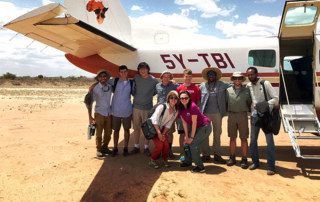
Welcome to the Origins Field School blog Spring 2018! My name is Deming Yang, Resident Academic Director for the field school. I will be accompanying the students, TA’s and instructors throughout all of the field school modules. As part of the Field School support team, I will do my best to make sure that our [...]
2018-04-30T07:00:14+03:00January 24th, 2018|Field Schools, Spring 2018|Comments Off on Origins Field School Spring 2018 begins!

TBI assists local communities in the wake of disastrous floods

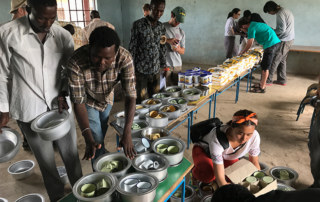
On Tuesday May 30th, a vast storm hit the Ileret area and brought an immense amount of rain. Within a short period of 9 hours, TBI Ileret facility documented a record-high rainfall of more than 200 mm (8 inches). This amount is much more than a typical rainstorm at Ileret (~20 mm), and more than [...]

2017-08-15T15:59:20+03:00June 20th, 2017|Featured, Field Schools, Global Innovation 2017, Global Innovation Field School, Local Community Outreach|Comments Off on TBI assists local communities in the wake of disastrous floods

Global Innovation Field School 2017 begins!

As most people are enjoying the beach and sunshine in the US, some Stony Brook students took a long shot and came to the shores of Lake Turkana, Kenya. They are here for the brand-new Global Innovation Field School! The Global Innovation summer program is organized by the College of Engineering & Applied Sciences, Stony [...]

2017-06-04T16:54:59+03:00May 27th, 2017|Featured, Field Schools, Global Innovation 2017|Comments Off on Global Innovation Field School 2017 begins!

Congratulations to Spring Field School Graduates!

It is finally the end of the Archaeology module and our field school students have learned a lot about stone tools. Now it is time to put them in good use! Cracking nuts using a hammer stone and an anvil is just the beginning of technology. To convince ourselves that the stone flakes we made are capable [...]

2017-06-04T17:01:35+03:00May 12th, 2017|Featured, Field Schools, Spring 2017|Comments Off on Congratulations to Spring Field School Graduates!

Some serious digging in the dirt

As the field school comes close to its end, students finally had the opportunity to experience how different pieces of information can be put together to tell a compelling story of human history. And we do it the TBI style: in the field! Equipped with all kinds of digging tools ranging from trowels to buckets, [...]

2017-04-27T21:47:03+03:00April 27th, 2017|Field Schools, Spring 2017|Comments Off on Some serious digging in the dirt

The grandeur of Lothagam

The TBI Turkwel campus has one of the best outlook points around the area: the roof of the research labs. From there, several landmarks in the region are clearly visible. Towards the south, there are two peaks barely noticeable above the horizon. They are in the area known as Lothagam, geologically one of the most [...]

2017-04-30T15:15:36+03:00April 20th, 2017|Field Schools, Spring 2017|Comments Off on The grandeur of Lothagam

The Nariokotome camping trip

Now that our field school students have gained a good understanding of how early stone tools are made, it is time to find some stone tools in the field! And that is what the students have been waiting for! The Origins Field School has a tradition of visiting one of the most well-known hominin sites [...]

2017-04-12T20:39:37+03:00April 12th, 2017|Field Schools, Spring 2017|Comments Off on The Nariokotome camping trip

Visiting hominin ancestors

It is now the second week of the human evolution module of the Origins Field School and our dedicated students are ready for a new set of adventures! In the classroom, we have been learning about how different evolutionary theories have been developed around a rather limited hominin fossil record. With all the gaps in [...]

2017-03-27T12:34:23+03:00March 27th, 2017|Field Schools, Spring 2017|Comments Off on Visiting hominin ancestors

A family tree of Caminalcules

Families are considered functional units of a typical human society. Depending on the geographic and cultural origin, families can come in different shapes and sizes. The most straightforward way to relate all the members of an extended family is to draw a family tree. Most people know their immediate relatives such as a parent or [...]

2017-03-26T12:44:25+03:00March 22nd, 2017|Field Schools, Spring 2017|Comments Off on A family tree of Caminalcules

Nom nom nom…

Origins Field School students don’t have to worry about what's for dinner, as we are provided with healthy and delicious food every day. But what is on the menu for other animals? How can we use them to infer the diet of their fossil relatives?

2017-03-13T14:03:24+03:00March 12th, 2017|Spring 2017|Comments Off on Nom nom nom…

Earth’s history unrolled

Where does the world come from is one of the most fascinating questions people have asked for thousands of years. Needless to say, the Earth came a long way before it took the shape that we can recognize today. How do we know about major Earth history events such as splitting up of continents, appearance [...]

2017-03-08T08:21:37+03:00March 8th, 2017|Spring 2017|Comments Off on Earth’s history unrolled

In search of old bones

In the Geology module of the Origins field school, student learned about the earth’s history and how this history is recorded in the layers of sediment in the Turkana Basin. Now it is time to decipher the enigma of different plants and animals that lived in the history of the Turkana Basin millions of years [...]

2017-03-03T04:54:03+03:00March 3rd, 2017|Spring 2017|Comments Off on In search of old bones

How muddy business turns into discoveries

In our last episode of geologic endeavor, students learned about the two dominating sedimentary systems of the Turkana Basin: the river system and the lake system. They are the integral forces that laid down layers of rocks in the basin, together with important fossils of early mammals and hominins. To understand the differences between the [...]

2017-02-19T01:15:22+03:00February 19th, 2017|Spring 2017|Comments Off on How muddy business turns into discoveries

Cheetah at Mpala Research Centre

Origins Field School students observe cheetah at Mpala Research Centre in central Kenya. Studying the wildlife of a modern East African savanna ecosystem provides students an analog for studying the ancient environment of the Lake Turkana Basin, which millions of years ago was much more lush and green than today.

2017-07-14T12:28:35+03:00February 8th, 2017|Video|Comments Off on Cheetah at Mpala Research Centre

Hippos at Mpala Research Centre

  Students of the Turkana Basin Institute Origins Field School observe a Hippo pod at Mpala Research Centre in central Kenya. Part of the Ecology course of the program, students' experiences at Mpala provide a context for visualizing the ancient landscape of Lake Turakana several million years ago.

2017-01-24T08:27:13+03:00January 23rd, 2017|Field Schools, Spring 2017|Comments Off on Hippos at Mpala Research Centre
Go to Top