turk@n@b@sinhB3d1x

About Turkana Basin Institute

This author has not yet filled in any details.
So far Turkana Basin Institute has created 611 blog entries.

Nom nom nom…

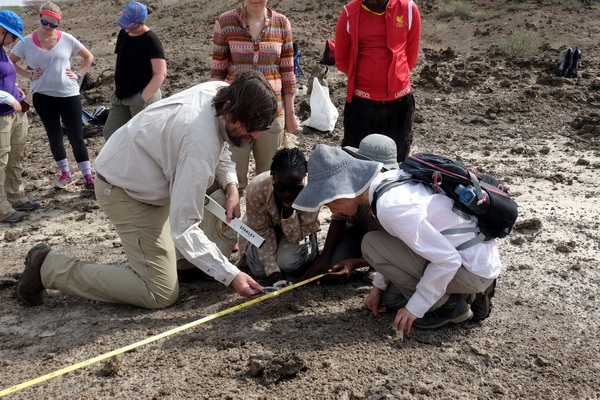
Origins Field School students don’t have to worry about what's for dinner, as we are provided with healthy and delicious food every day. But what is on the menu for other animals? How can we use them to infer the diet of their fossil relatives?

2017-03-13T14:03:24+03:00March 12th, 2017|Spring 2017|Comments Off on Nom nom nom…

Earth’s history unrolled

Where does the world come from is one of the most fascinating questions people have asked for thousands of years. Needless to say, the Earth came a long way before it took the shape that we can recognize today. How do we know about major Earth history events such as splitting up of continents, appearance [...]

2017-03-08T08:21:37+03:00March 8th, 2017|Spring 2017|Comments Off on Earth’s history unrolled

In search of old bones

In the Geology module of the Origins field school, student learned about the earth’s history and how this history is recorded in the layers of sediment in the Turkana Basin. Now it is time to decipher the enigma of different plants and animals that lived in the history of the Turkana Basin millions of years [...]

2017-03-03T04:54:03+03:00March 3rd, 2017|Spring 2017|Comments Off on In search of old bones

“Where we’re going, we don’t need roads”

To put their geology skills to the test, students set out to make a geological map of area 1, which is near our home in Ileret.  This map not only included essential features such as a key, a compass showing where north is, and a scale, but also important geological features including tuffs, ancient river [...]

2017-02-24T22:07:14+03:00February 24th, 2017|Spring 2017|Comments Off on “Where we’re going, we don’t need roads”

How muddy business turns into discoveries

In our last episode of geologic endeavor, students learned about the two dominating sedimentary systems of the Turkana Basin: the river system and the lake system. They are the integral forces that laid down layers of rocks in the basin, together with important fossils of early mammals and hominins. To understand the differences between the [...]

2017-02-19T01:15:22+03:00February 19th, 2017|Spring 2017|Comments Off on How muddy business turns into discoveries

A Window Into The Rocks

Our first module came to an end, which unfortunately meant it was time to say goodbye to Dino and his adorable field assistant Barabara.  Ecology has set the stage for the rest of the Origins Field School, especially our next adventure, geology.  Geological processes that have formed our current ecology have not changed throughout time. Thus [...]

2017-02-18T14:38:31+03:00February 17th, 2017|Field Schools, Spring 2017|Comments Off on A Window Into The Rocks

Cheetah at Mpala Research Centre

Origins Field School students observe cheetah at Mpala Research Centre in central Kenya. Studying the wildlife of a modern East African savanna ecosystem provides students an analog for studying the ancient environment of the Lake Turkana Basin, which millions of years ago was much more lush and green than today.

2017-07-14T12:28:35+03:00February 8th, 2017|Video|Comments Off on Cheetah at Mpala Research Centre

Our New Home, Ileret.

We are now in Ileret, which is on the east side of Lake Turkana. We will be here for 7 weeks of the field school! Map of Lake Turkana. Ileret is on the northeastern side of the lake. Student dorms at TBI Ileret. Photo credit Deming Yang. TA Laura pretending [...]

2017-02-05T10:11:37+03:00February 5th, 2017|Spring 2017|Comments Off on Our New Home, Ileret.

Cheetahs and Rhinos and Dogs, Oh My!

During our last few days at Mpala, the students were immersed in the unique wild life and vegetation of Laikipia. Professor Dino Martins, director of Mpala, brought the students into the field to teach them about different forms of between species interactions. One example of this type of interaction is mutualism; where each species receives [...]

2017-02-05T01:17:21+03:00February 1st, 2017|Spring 2017|Comments Off on Cheetahs and Rhinos and Dogs, Oh My!

Students take the field for ecology

After a few days of getting settled into their routine at Mpala research center, the students were ready to begin their first module: Ecology.  For an introduction into dry land plants, Kenyan Botanist, Kimani, took the students around the research compound to look at the local plant life. Kimani showing the students different types [...]

2017-01-27T05:18:56+03:00January 27th, 2017|Spring 2017|Comments Off on Students take the field for ecology

Hippos at Mpala Research Centre

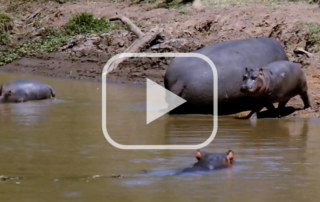
  Students of the Turkana Basin Institute Origins Field School observe a Hippo pod at Mpala Research Centre in central Kenya. Part of the Ecology course of the program, students' experiences at Mpala provide a context for visualizing the ancient landscape of Lake Turakana several million years ago.

2017-01-24T08:27:13+03:00January 23rd, 2017|Field Schools, Spring 2017|Comments Off on Hippos at Mpala Research Centre

TBI Origins Field School Spring 2017 Begins!

Welcome to the Turkana Basin Institute field school blog Spring 2017! As the Resident Academic Director for the field school, I will be accompanying the students, TA's and instructors throughout all of the field school modules. It is my goal to ensure that the students have an incredible learning experience that they will carry with [...]

2017-06-04T16:57:28+03:00January 23rd, 2017|Field Schools, Spring 2017|Comments Off on TBI Origins Field School Spring 2017 Begins!

Fall 2016 Field School ends :(

This past semester has been one to remember. The students learned about the Ecology of the Turkana Basin, being able to identify all the common plant species in the region and understanding how animals foraging on these plants have affected the environment. They learned about the Geology of the Turkana Basin, where each and every [...]

2017-01-04T18:04:29+03:00November 30th, 2016|Fall 2016, Field Schools|Comments Off on Fall 2016 Field School ends :(

Stony Brook professor publishes stone tool book

Stony Brook University professor John J. Shea recently published a new work through Cambridge University Press entitled Stone Tools in Human Evolution: Behavioral Differences among Technological Primates. From the publisher's description: In Stone Tools in Human Evolution, John J. Shea argues that over the last three million years hominins' technological strategies shifted from occasional tool use, [...]

2017-01-04T18:04:29+03:00November 28th, 2016|General|Comments Off on Stony Brook professor publishes stone tool book

Becoming a master knapper

After returning to TBI from an exciting camping trip, we spent the afternoon relaxing and knapping! We used the raw material we had collected in the field: though everyone put their initials on the material collected, some students decided to share what they had collected (our students were so thoughtful, but whatever happened to survival [...]

2017-01-04T18:04:29+03:00November 21st, 2016|Fall 2016, Field Schools|Comments Off on Becoming a master knapper

Trip to Nariokotome

We left TBI Turkwel Monday morning for our camping trip, from which we would be returning on Wednesday afternoon. We would be camping for two nights near the village of Nariokotome; the famous hominin site of Nariokotome boy, KNM-WT 15000, is only a few minutes away! On our drive to Nariokotome, we would be making [...]

2017-01-04T18:04:29+03:00November 19th, 2016|Fall 2016, Field Schools|Comments Off on Trip to Nariokotome

Rolling back to the Holocene

On Friday, we traveled to the Holocene site of Napaget, a massive and artefact-rich sand dune that overlooks the beautiful Lake Turkana. The site is about an hour away (as the lorry drives), and on the way we passed some truly impressive termite mounds, almost big enough for a person to live in (I wonder [...]

2017-01-04T18:04:30+03:00November 14th, 2016|Fall 2016, Field Schools|Comments Off on Rolling back to the Holocene

Afternoon Knaps

The next morning in class, we were introduced to archaeological vocabulary, necessary to accurately understand and describe stone artefacts. We learned how to describe the physical characteristics, such as: ventral (internal) and dorsal (external) sides of a flake; cortex, or the external skin of the original rock; and negatives (signs of a flake removal) and positives [...]

2017-01-04T18:04:30+03:00November 13th, 2016|Fall 2016, Field Schools, General|Comments Off on Afternoon Knaps
Go to Top